
For a parrot, a toy isn't just a bit of fun—it's a critical part of a happy, healthy life. The right toys for parrots are the stand-ins for all the mental puzzles and physical work they’d be doing out in the wild. If you're looking after a parrot in Australia, creating an environment that keeps their mind busy is one of the most important things you can do for their wellbeing.
Why The Right Toys Are Crucial For Your Parrot
Imagine being stuck in one room all day with absolutely nothing to do. You’d get bored and frustrated pretty quickly, right? That’s what life is like for a parrot without enough to keep its mind occupied, and it’s a fast track to some serious behavioural issues.
Out in the Australian bush, parrots spend most of their day on the move. They're foraging for food, figuring out how to get from A to B, and interacting with their flock. Their brains are wired for that constant buzz of activity. When we bring these incredibly smart birds into our homes, it becomes our job to provide that same sense of purpose.
Fulfilling Natural Instincts
Toys aren’t just for play; they’re tools that let your parrot act on its natural instincts in a safe and appropriate way. A parrot’s beak is like its hand—it’s for climbing, exploring, and pulling things apart. Destructible toys, like our popular Wooden Wonderland Parrot Toy, are perfect for satisfying that deep-seated need to chew and shred.
Without a proper outlet, that chewing instinct can easily turn to your furniture, door frames, or even their own feathers. Giving them a good variety of toys to destroy helps prevent destructive habits before they even start.
Expert Advice: "A bored parrot is an unhappy parrot. Enrichment isn't a luxury; it's a necessity for their psychological wellbeing. Behavioural issues like screaming and feather plucking are often distress signals indicating a lack of mental engagement."
Preventing Common Behavioural Issues
Many of the parrot behaviours that frustrate owners are just symptoms of a clever mind with nothing to do. An empty, boring cage can lead to a host of problems that are much harder to fix later on.
- Feather Plucking: This is often a sign of major stress or boredom. Parrots might start over-preening or pulling out their own feathers simply to have something to do.
- Incessant Screaming: All parrots make noise, but non-stop screaming can be a cry for attention or a way of releasing pent-up energy when there’s no other outlet.
- Aggression: A frustrated bird can become nippy or aggressive towards people because it has no other way to express itself.
- Repetitive Behaviours: Actions like pacing back and forth or constant head-bobbing can start when a parrot has nothing else to focus on.
By providing a rotating selection of interesting toys, like a tricky Foraging Wheel or a shreddable Balsa Box, you give their energy a positive focus. You’re not just buying playthings; you're investing in your parrot's mental health and building a better, more peaceful relationship with them.
Understanding The Different Types Of Parrot Toys
Walking into a pet supply store and seeing a wall of colourful parrot toys can feel a bit overwhelming. But it gets a lot simpler when you stop thinking about what the toy is, and start thinking about why your bird needs it. A great toy collection isn't about having the most stuff; it’s about covering all your bird's instinctual bases.
Think of it like this: you might read a book for mental stimulation and go for a run for physical exercise. Parrots are the same. They need different activities to stay happy and balanced. Some toys are for thinking, some are for shredding, and others are for getting their body moving. Once you understand the main categories, you can build a collection that genuinely enriches your bird's life.
Foraging Toys For Mental Stimulation
In the wild, a parrot's day is one big scavenger hunt. They spend a huge amount of their time searching for food—a behaviour we call foraging. That instinct doesn't just disappear in captivity, and foraging toys are the perfect way to satisfy it by turning mealtime into a fun puzzle.
Instead of just dropping food into a bowl, a foraging toy makes your parrot work for their reward. This could mean pulling a lever, opening a little drawer, or spinning a wheel to get to a treat. This problem-solving is incredibly stimulating for their sharp minds. For a great starting point, the Shreddable Foraging Box gets your bird chewing and digging to find whatever you’ve hidden inside.
Expert Advice: Start with easy foraging toys to build your bird’s confidence. If a puzzle is too hard straight away, they’re likely to just give up. Show them how it works, and as they get the hang of it, you can gradually introduce more challenging puzzles.
Destructible And Chew Toys For Beak Health
A parrot’s beak never stops growing, a bit like our fingernails. Chewing isn't just a destructive habit; it's an absolutely essential activity that helps them keep their beak in great shape and at a healthy length. Providing safe, destructible toys for parrots gives them the perfect outlet for this natural drive.
These are the toys your bird is supposed to destroy. They’re made from materials like soft balsa wood, cardboard, palm leaves, or yucca. The satisfaction they get from ripping, tearing, and shredding these items is huge and works as a fantastic stress reliever.
- Satisfies Natural Instincts: It mimics the way they would chew on wood and strip bark in their natural habitat.
- Prevents Unwanted Chewing: It directs all that chewing energy away from your furniture, skirting boards, or cage bars.
- Promotes Physical Engagement: Tearing apart a toy is a great physical workout for their beak, neck, and even their feet.
Preening And Shredding Toys
Preening is how a parrot grooms and arranges its feathers to keep them in top condition. But sometimes, especially out of boredom or stress, this can turn into over-preening or even feather plucking. Preening toys give them a safe alternative to focus these grooming instincts on.
These toys are often made from materials that have a similar feel to feathers, like shredded paper, sisal rope, or soft fabrics. When your bird pulls and grooms the toy, it satisfies that deep-seated preening urge without them causing any harm to their own beautiful plumage. The Colourful Shredder Delight is a perfect example, with layers of vibrant paper just begging to be shredded and tidied.
Foot Toys For Dexterity
Not all toys have to hang from the cage. Foot toys are small, lightweight items a parrot can hold in its feet to move around and chew. They’re brilliant for improving dexterity, coordination, and grip strength, and are especially important for species like many Australian parrots that naturally hold food with their feet.
From little wooden blocks and plastic balls with bells inside to woven vine rings, foot toys provide simple, on-the-go fun. You can leave them on a flat surface, a play gym, or scattered at the bottom of the cage for your bird to find. Something like the Wicker Rattle Ball is a perfect, easy-to-grab option to get started with.
How To Choose Toys For Your Parrot's Species
Giving a toy built for a tiny Budgie to a powerful chewer like a Galah isn’t just a waste of money—it's a serious safety risk. On the flip side, a massive toy made for a Macaw would be an intimidating and unusable lump of wood for a little Cockatiel.
Choosing the right toys for parrots really boils down to understanding your specific bird's size, beak strength, and natural instincts.
Every species plays differently, shaped by millions of years of evolution. Small, nimble birds often love lightweight foot toys they can toss around, while big parrots with mighty beaks need chunky, destructible toys to really sink their beaks into. But don't forget, your bird's individual personality is just as important as its species' general traits.
Matching Toys To Beak Strength
A parrot's beak is an incredibly powerful tool. The force it can exert is the deciding factor in what materials are safe and which ones will be confetti in seconds—or worse, cause an injury. You have to match the toy’s durability to your bird’s beak power. Simple as that.
- Small Birds (Budgies, Cockatiels, Lovebirds): These little guys have less powerful beaks and get the most joy from softer, shreddable materials. Think balsa wood, sola, palm leaves, and thin cardboard. They need toys that are easy to break apart to feel a real sense of accomplishment.
- Medium Birds (Conures, Galahs, Ringnecks): This group packs a surprising punch and needs more robust toys to keep them busy. They do well with medium-density woods, tougher plastics, and intricate foraging puzzles that can withstand some serious attention.
- Large Birds (Amazons, Cockatoos, Macaws): Welcome to the demolition crew. These are the power-chewers of the parrot world, and they require toys made from hard, dense woods, thick acrylic, and strong ropes. Any metal parts absolutely must be stainless steel to stand up to their beaks. Providing tough options, like our range of durable Amazon parrot toys, is essential for their safety and enrichment.
This simple decision tree can help you figure out what kind of enrichment your parrot might need most right now—whether it's a puzzle for their clever brain, a good chunk of wood to chew, or soft materials for preening.
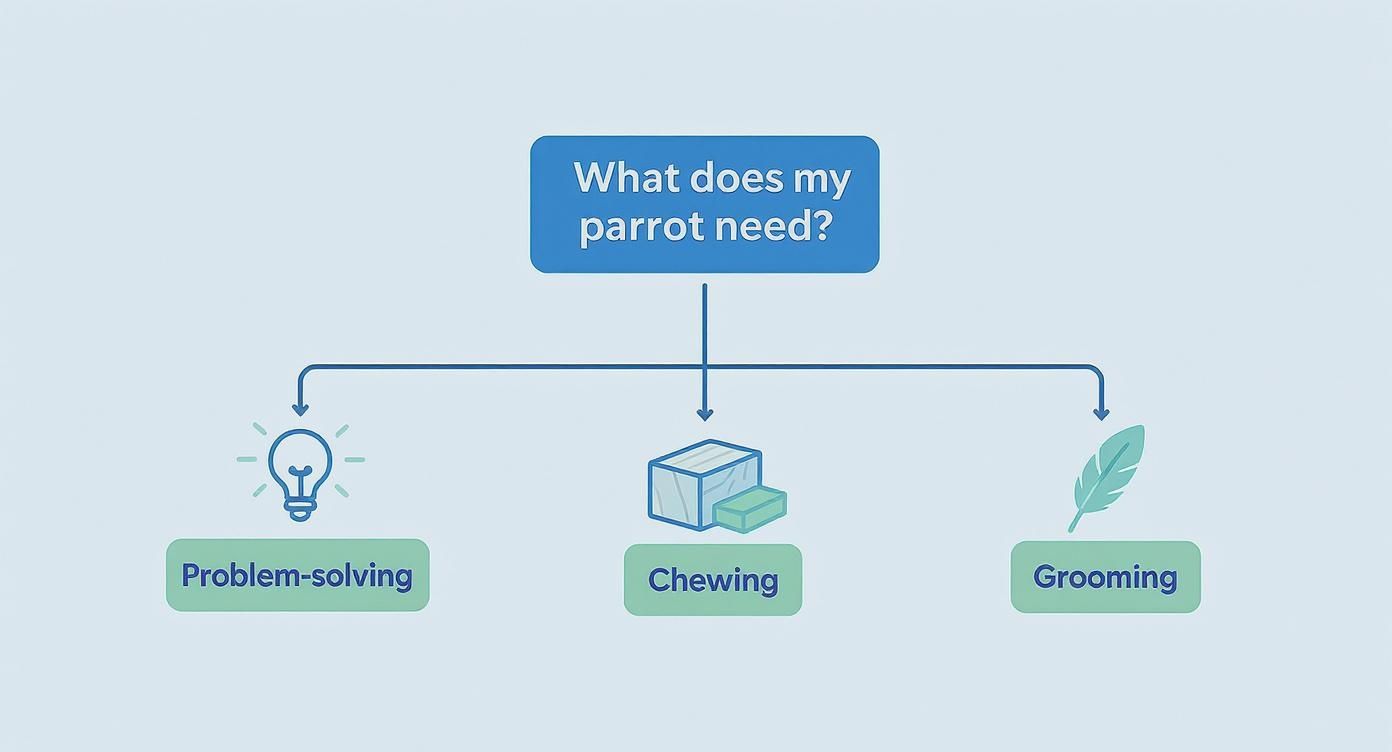
The main takeaway here is that a well-rounded toy collection addresses multiple needs, ensuring your parrot stays stimulated both mentally and physically.
Australian Parrot Toy Selection Guide By Species
Australia is home to some of the world's most charismatic parrot species. To make things a bit easier, here’s a quick guide to help you choose the best toys for a few common Aussie companions.
| Parrot Species | Recommended Toy Types | Safe Materials | Things To Avoid |
|---|---|---|---|
| Budgerigar | Shredding toys, small foot toys, foraging puzzles with tiny parts, lightweight swings. | Balsa, sola, paper, yucca, thin plastic beads, natural vine balls. | Heavy wood blocks, thick ropes, large metal parts that could trap a head or foot. |
| Cockatiel | Preening toys, shreddable paper, small wooden blocks, bells, and ladders. | Soft woods, sisal rope, cardboard, leather strips (vegetable-tanned only). | Toys with small, easily swallowed parts or cotton fibres that can cause impaction. |
| Galah | Destructible wood toys, foraging boxes, swings, and complex puzzles. | Pine, gum nuts, bottle brush, acrylic foraging toys, stainless steel hardware. | Soft plastic toys that can be easily ingested, toys with zinc-coated hardware. |
| Sulphur-Crested Cockatoo | Large, very durable wood blocks, tough acrylic puzzles, heavy-duty swings. | Hard Australian native woods, thick ropes, stainless steel chains, bolts. | Any toy that can be dismantled quickly, small parts, softwood intended for smaller birds. |
This table is a great starting point, but remember every bird is an individual.
Expert Advice: "Always observe how your parrot interacts with a new toy. Some birds are gentle, while others are demolition experts. Their individual play style is your best guide for future purchases."
Ultimately, providing the right toys for your parrot's species is a true act of love. It shows you understand their unique needs and are committed to giving them a rich, stimulating life.
Your Essential Parrot Toy Safety Checklist
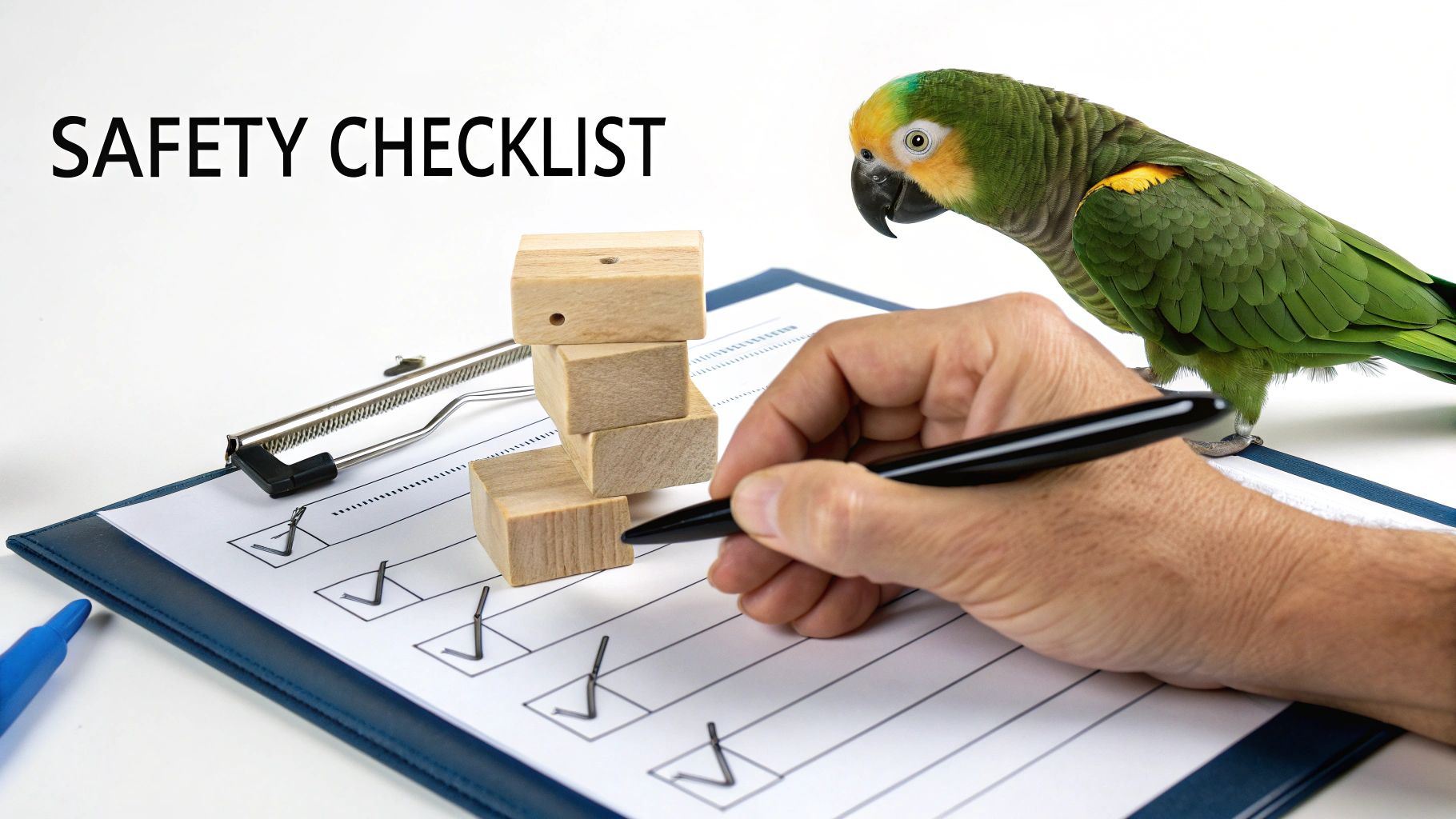
While the whole point of toys for parrots is to bring joy and enrichment into their lives, nothing trumps safety. A parrot's beak is a powerful tool, and their curiosity is boundless—they will find every single weak spot in a toy. For any Australian parrot owner, learning to spot a potential hazard before it causes harm isn't just a good idea, it's an essential skill.
Think of this checklist as your go-to guide for keeping playtime both fun and secure. It'll give you the confidence to assess any toy, whether it's brand new from the shop or a well-loved favourite that's been in the cage for a while.
First, Inspect The Materials
The absolute first thing to check is what the toy is made of. Not all woods, metals, and plastics are created equal in the parrot world, and knowing the difference can prevent serious, and sometimes hidden, health problems.
- Wood: Always stick to untreated, natural woods. Here in Australia, we have fantastic native options like bottlebrush, eucalyptus (gum), and banksia. Steer clear of things like particleboard or MDF, as they’re held together with toxic glues.
- Plastics: For birds with strong beaks, only hard, durable plastics like acrylic or specific bird-safe PVC are suitable. Soft plastics are far too easy to break off and swallow, which can lead to life-threatening blockages.
- Dyes: Any colour on a toy should come from non-toxic, food-grade dyes. A quick test is to get it wet—if the colour runs, it's best to avoid it.
- Fabrics and Ropes: Natural fibres like sisal, jute, or hemp are much safer choices. You should never use cotton rope or fabric in toys your bird has unsupervised. The long threads are a major risk for crop impaction if swallowed, and can easily wrap around toes or legs, cutting off circulation.
Scrutinise The Hardware and Construction
How a toy is put together is just as important as what it's made from. It’s often the small, seemingly insignificant metal bits that pose the biggest risks if they aren’t up to scratch. A single weak link can quickly turn a fun toy into a genuine danger.
Take a really close look at the small metal components holding everything together.
Expert Advice: "Zinc and lead toxicity are serious and unfortunately common issues seen by avian veterinarians in Australia. Always choose stainless steel hardware. It costs a bit more, but it’s completely non-toxic and strong enough to withstand even the most powerful beaks."
The safest, most reliable choice for chains, quick links, bells, and any other metal part is stainless steel. Reputable suppliers will always state this clearly. For anyone keen on making their own toys safely, our exclusive collection of stainless steel bird toy parts is the perfect place to start. Avoid anything galvanised or coated in shiny metals, as these are notorious for containing toxic zinc.
Check For Hidden Dangers And Traps
A toy can look perfectly fine at first glance, but it might be hiding dangers that only appear once your parrot starts pulling it apart. This is why regular inspections are so crucial—they help you spot these lurking hazards before an injury happens.
Your safety check should always include looking for these things:
-
Small Gaps: Check for any rings, holes, or gaps where a head, beak, or even a single toe could get stuck. Quick links should always be pinched tightly closed, and any O-rings should be properly welded shut.
- Easily Swallowed Parts: If a part looks small enough for your bird to swallow, assume they will try. This is particularly critical for smaller birds like budgies and cockatiels.
- Sharp Edges: As a toy gets chewed and destroyed (which is the whole point!), it can develop sharp splinters or edges. Make a habit of sanding down or trimming off any dangerous points.
- Frayed Ropes: Trim any long, frayed strands on rope toys immediately. This simple act prevents entanglement and stops your bird from swallowing the fibres. Once a rope toy is overly shredded, it's time to replace it.
By running through this checklist regularly, you can create a stimulating environment for your feathered friend while ensuring they stay happy, healthy, and out of harm's way.
Building An Enriching Environment With Toy Rotation
Simply stuffing your parrot’s cage with every toy imaginable isn't the key to a happy bird. For a creature as intelligent as a parrot, real enrichment comes from a world that changes and offers new things to discover. This is where a simple but brilliant strategy comes into play: toy rotation.
Think about it like this: if you had to read the same book or watch the same movie every single day, you’d eventually just tune it out. It's no different for your parrot. When toys become permanent fixtures, they just fade into the background and lose all their magic. Regularly swapping them out keeps their environment fresh, exciting, and full of new challenges to figure out.
This is a real investment in their mental health, and it's a concept that Australian pet owners are really starting to embrace. We're understanding just how vital enrichment is for keeping boredom and stress at bay for our feathered friends.
Creating Your Toy Rotation Plan
A good rotation plan doesn’t need to be complicated. The whole point is to create a cycle that keeps things interesting without making your bird feel overwhelmed. It's about quality, not just cramming more stuff in.
As a rule of thumb, try to have no more than three to five toys in the cage at any one time, depending on its size. This stops the cage from feeling cluttered and gives your bird a chance to actually interact with each item. Any more than that can just create chaos and even make them anxious.
Getting started is easy:
- Build a Collection: Gather a good mix of toys from different categories—things to chew, shred, forage with, and foot toys. Aim to have at least two or three different "sets" of toys ready to go.
- Set a Schedule: Plan to swap out one or two toys every week. This creates a steady flow of "new" things to check out without completely changing their entire home all at once.
- Clean and Store: When you take toys out, give them a good clean and check for any damage. Store them somewhere your bird can’t see them, so they feel brand new when they make a comeback in a few weeks.
Expert Advice: "When a toy is reintroduced after being stored away for a few weeks, a parrot often greets it with the same enthusiasm as a brand-new purchase. Rotation multiplies the value of your entire toy collection."
Introducing New Toys To A Cautious Bird
Some parrots can be a bit timid and get spooked by new things in their personal space. This fear of new objects is called neophobia, and it’s a natural survival instinct. If you try to force a new toy on a nervous bird, you'll only make them associate it with stress.
A much better approach is to introduce new items slowly and make it a positive experience. Try placing the new toy on the outside of the cage or on a nearby play stand for a few days. This lets your parrot watch it from a safe distance and get used to it being there. You can even play with the toy yourself to show them it's safe and fun. Once they start showing some curiosity, you can move it inside their cage.
This gentle method builds their confidence and teaches them that new things are exciting, not scary. For more ideas on using puzzles, have a look at our guide on the benefits of foraging toys for birds.
Got Questions About Parrot Toys? We've Got Answers
Even after doing your research, it’s completely normal to have a few questions buzzing around. We all want to do the absolute best for our birds, and sometimes the little details can feel tricky. So, let's clear up some of the most common queries we hear from parrot people across Australia.
This is all about giving you the confidence to make great choices, whether you're wondering how long a toy should last or how to deal with a bird that's scared of everything new.
How Often Should I Replace My Parrot's Toys?
There's no magic number here. The real answer depends entirely on the toy's material and just how much your parrot enjoys a good demolition session. A tough acrylic foraging toy might be part of the furniture for years, but a soft balsa wood toy like our Hanging Bag Shredable Bird Toy could be reduced to splinters in a single afternoon by a determined Major Mitchell's—and that's a good thing!
Forget the calendar. The trick is to replace toys based on their condition.
- Destructible Toys: These are made to be wrecked. Once your bird has chewed, shredded, or pulled it apart, its job is done. Time for a new one.
- Rope and Fabric Toys: The moment they start looking heavily frayed, it's time for them to go. This stops any risk of your bird getting tangled up or ingesting long fibres.
- Foraging and Puzzle Toys: These are built to last, but keep an eye out for cracks or breaks. If any small parts come loose that could be swallowed, it's time to retire the toy.
Getting into the habit of giving every toy a quick once-over each day is the best way to stay on top of things.
A Quick Tip: "Never see a destroyed toy as wasted money. Think of it as a huge success! A toy that's been torn to shreds is proof your parrot has been busy, engaged, and happy. That’s the whole point of enrichment."
Are DIY Parrot Toys From Household Items Safe?
Making your own toys can be a great, budget-friendly way to keep things interesting for your bird, but it comes with a massive warning: you have to be 100% certain every single part is bird-safe. It’s so tempting to use things from around the house, but many of them hide dangers. Cardboard toilet paper rolls can contain toxic glues, and that odd scrap of yarn might have synthetic fibres that are dangerous if ingested.
If you’re keen to get creative, always get your materials from a supplier that specialises in bird-safe parts. Using quality components, like the ones in our stainless steel parts range, means you can build something that's both fun and completely safe.
What Is The Best Way To Introduce New Toys To A Fearful Parrot?
It’s incredibly common for parrots to be suspicious of new things in their space. This fear, called neophobia, is a deep-seated survival instinct. The worst thing you can do is force a new toy on a scared bird; it just breaks their trust. The key is a slow, patient introduction.
Start by just placing the new toy on a table outside the cage, somewhere your bird can see it from a distance. Just leave it there for a few days. Let them get used to the sight of it. You can even pick it up and play with it yourself, showing them it's nothing to worry about.
Once your bird starts showing a bit of curiosity—maybe leaning in its direction or watching you closely—you can try moving it inside the cage. Don't hang it right next to their favourite perch; put it on the other side of the cage. This gentle approach builds confidence and can turn a scary object into an exciting new challenge, like our popular Game on bird toy.
Where to Go From Here?
Your journey into giving your feathered friend the best possible life doesn't stop here. Far from it! Keeping a parrot happy, healthy, and engaged is an ongoing adventure, full of little discoveries and learning curves. By staying curious and open to new ideas, you're not just being a great owner—you're deepening that incredible bond you share and making sure their world stays bright and interesting.
Trying to source all the essentials for your bird can feel like a bit of a mission sometimes, but finding a reliable local supplier makes all the difference. To make sure you've got access to a fantastic range of safe and stimulating products, from food to toys, check out our guide to finding the best parrot supplies in Australia. Arming yourself with the right gear and knowledge is truly the best gift you can give your intelligent companion.
At Lou Lou Bells Bird Toys, we are passionate about providing the highest quality, Australian-made and sourced toys to help your parrot thrive. Explore our full range of enrichment options today.
https://louloubellsbirdtoys.com.au
Keep Reading
- Choosing the Perfect Bird Perch Stand
- Your Guide to the Perfect Bird Flight Cage
- A Guide to Parrot Cage Accessories
Disclaimer Summary:
The information in this article is general in nature and may include external links or resources not created by Lou Lou Bells Bird Toys. Every bird is unique, so we encourage you to seek personalised advice from your own veterinarian or avian specialist. For full details, please read our complete disclaimer here.