
Foraging is a powerful, hard-wired instinct for any parrot, and in-shell almonds are a brilliant way to tap into that natural drive. The simple act of cracking open a shell isn't just a snack—it's mental stimulation and physical exercise rolled into one, turning a simple treat into a fantastic enrichment tool. Offered the right way, these nuts are a safe and seriously engaging activity for most companion birds.
More Than a Treat: The Power of In-Shell Almonds
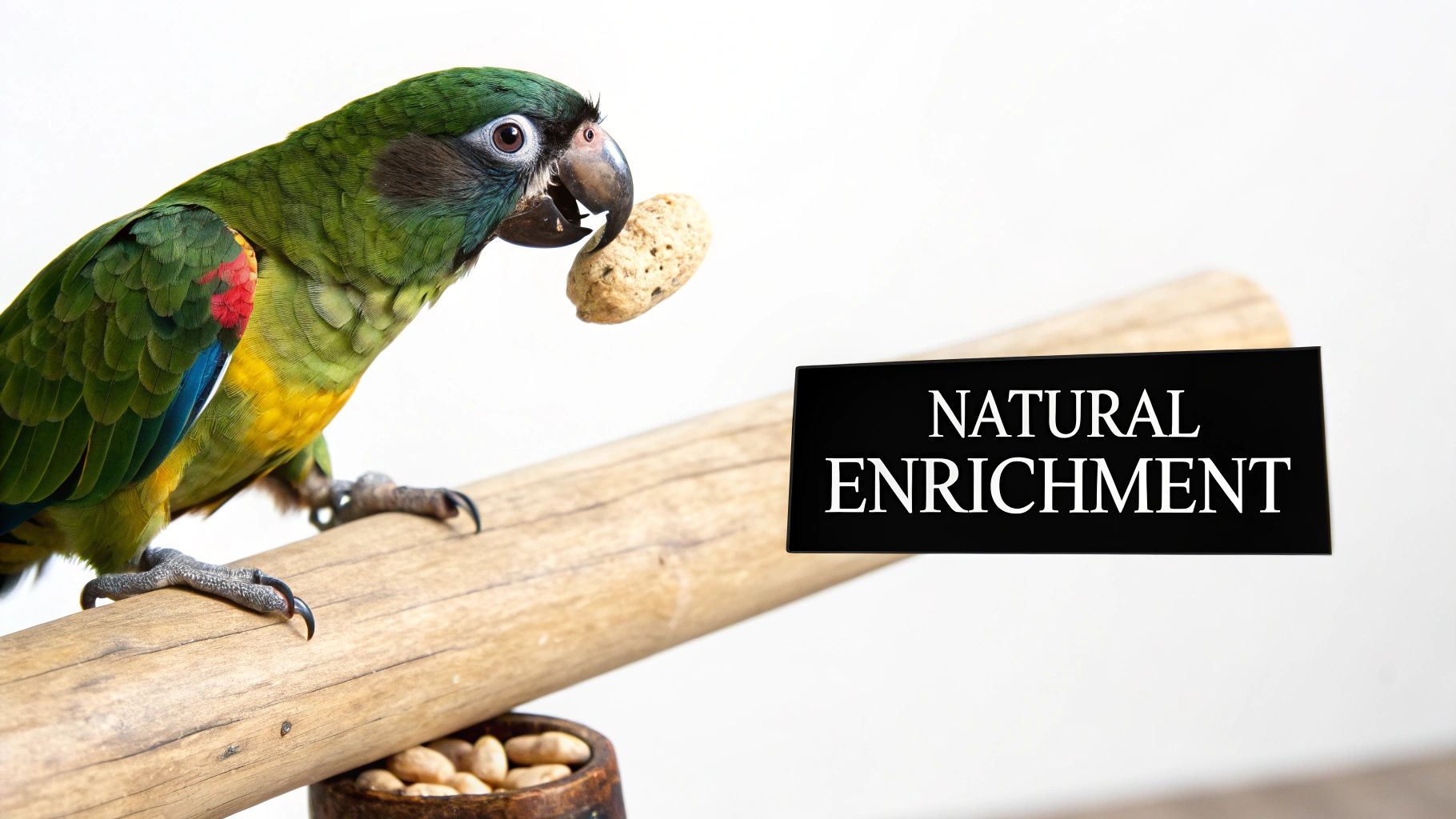
Ever watched your parrot get completely absorbed in dismantling a toy, piece by tiny piece? That laser focus is a window into their wild instincts. Out in their natural habitat, parrots spend a huge chunk of their day hunting for, finding, and breaking into their food. This whole process, which we call foraging, is absolutely essential for their psychological wellbeing.
When we just plonk food in a bowl, we accidentally strip away that vital challenge. An in-shell almond helps bring it back. The hard, protective shell becomes a puzzle your bird has to solve with its beak and feet, engaging both its mind and body in a really rewarding way.
The Connection Between Shells and Instinct
For a parrot, an almond still in its shell isn't just food; it’s an opportunity. The experience satisfies a deep behavioural need that goes way beyond just filling their belly.
-
Mental Stimulation: Cracking the shell takes problem-solving skills, concentration, and dexterity. This mental workout is great for preventing boredom and the frustrating behaviours that can come with it, like feather plucking.
-
Physical Exercise: Working on and breaking open the shell strengthens your bird’s beak, jaw muscles, and even their feet as they grip the nut tight. It’s a fantastic outlet for their physical energy.
-
A Sense of Accomplishment: Finally getting that shell open and reaching the kernel inside provides a powerful feeling of success. This kind of positive reinforcement encourages natural, healthy behaviour and builds their confidence.
Expert Advice: Avian behaviourists are big fans of puzzle-based feeding to mimic what birds do in the wild. An in-shell almond is one of the simplest yet most effective foraging "toys" you can offer, promoting both physical health and mental sharpness.
Think of this guide as your complete resource for using in-shell almonds safely and creatively. We'll cover everything Australian bird owners need to know, from the nutritional side of things and important safety checks to fun foraging ideas that will keep your feathered mate happy and thriving.
Understanding In-Shell Almonds and Parrot Safety
Before you toss an almond to your feathered friend, it’s vital to understand that not all almonds are created equal. The in-shell almonds that are safe for parrots are a world away from the snacks we humans munch on. For your bird, it must be raw, unsalted, and unflavoured, straight from nature and still in its protective shell.
Human snacks are often roasted, salted, smoked, or drowned in flavours like chocolate or chilli. These extras are a big no-no for birds. Their sensitive systems just can't cope with the high salt, sugar, and artificial ingredients, which can be unhealthy or even toxic. When it comes to your parrot, always stick to the pure, natural stuff.
Sweet vs Bitter: A Critical Distinction
Here’s the most important safety rule of all: the type of almond matters immensely. The good news is that in Australia, this is pretty straightforward. All commercially grown and sold almonds are the sweet almond variety (Prunus dulcis), which are perfectly safe for parrots to enjoy in moderation.
You might have heard horror stories about toxic "bitter almonds." These come from a different tree (Prunus amygdalus var. amara) and contain a nasty compound that releases cyanide when chewed. Thankfully, you don’t need to lose sleep over this—they aren't sold for human (or animal) consumption in Australia, so you won't accidentally pick them up from a reputable grocer or pet supplier.
Expert Advice: Always buy your in-shell almonds from trusted human-grade food suppliers or specialised pet retailers in Australia. This is your best guarantee that you're getting safe, sweet almonds that have been stored properly to keep them fresh and nutritious.
Australia's Almond Landscape
When you choose Australian-grown in-shell almonds, you’re tapping into a huge, well-regulated agricultural industry. For local bird owners, this is fantastic news because it means a fresh, reliable, and high-quality supply is readily available.
In fact, almonds are Australia’s biggest nut crop by a long shot. Production figures show they make up a significant portion of all Australian tree-nut production by volume when measured in-shell. Much of the inedible hull and shell gets repurposed for things like livestock feed, which really shows the massive scale of the crop. You can dig deeper into Australia's nut production statistics to see just how dominant almonds are in our local farming.
With massive production centred in regions like the Riverland in South Australia and Sunraysia in Victoria, the almonds you buy for your parrot are often fresher and have travelled far less distance to get to you.
Key Safety Checks Before Offering
Even with the safest sweet almonds, it pays to develop the habit of a quick once-over. Before handing a nut to your bird, check that the shell is intact, free from cracks, and has no signs of mould or discolouration. A healthy nut should feel solid and not rattle too much when you give it a shake.
By following these simple rules—choose raw, buy from good sources, and do a quick visual check—you can confidently offer in-shell almonds as a safe and incredibly enriching treat for your parrot. Getting this foundation of safety right is non-negotiable for their long-term health and happiness.
The Good Stuff: What Almonds Bring to Your Bird's Diet
When your parrot finally cracks open that in-shell almond, they're not just having a snack; they're getting into a tiny powerhouse of nutrition. Think of it as a natural, all-in-one supplement that supports everything from their bright feathers down to their tiny, fast-beating heart. But just like a rich dessert for us, it’s all about moderation.
Almonds are a fantastic source of monounsaturated fats—the healthy kind. For a parrot that’s always on the move, these fats provide a brilliant, slow-release energy source to fuel their daily acrobatics and chatter. It’s a serious energy boost packed into a tiny shell.
Key Nutrients Hiding Inside
Beyond just energy, almonds are loaded with specific vitamins and minerals that play a huge part in your bird's overall health. They're much more than just empty calories.
-
Vitamin E: This powerful antioxidant is a real superstar for your bird's health. It helps keep their immune system strong, making them better equipped to fight off illness. It’s also brilliant for skin and feather condition, helping create that vibrant, glossy look we all love to see.
-
Magnesium: Essential for healthy nerves and muscles, magnesium is a key player in your bird's body. It helps manage everything from flying and perching to simply chattering away, ensuring their muscles and nerves are firing correctly.
-
Plant-Based Protein: Almonds offer a decent serving of high-quality plant protein. Protein is the fundamental building block for strong muscles, a healthy beak, and the constant, demanding process of growing new feathers.
Why Portion Control is Everything
As good as they are, almonds are undeniably high in calories and fat. This is where we, as responsible bird owners, need to be sensible. It helps to think of an almond as the parrot equivalent of a decadent slice of chocolate cake—wonderful as a special treat, but definitely not an everyday staple.
Overdoing it on high-fat nuts can lead to serious health problems like obesity and fatty liver disease, which can really impact your bird’s quality of life. The goal is to use almonds as a high-value reward for training or a special foraging challenge, not as a main meal. Knowing the right balance is a core part of providing excellent food for parrots.
Expert Advice: A bird's core diet should always be high-quality pellets, fresh vegetables, and a small amount of fruit. Treats like in-shell almonds should make up no more than 10% of their total daily food intake. This ensures they get all the essential nutrients they need without overdoing it on the fats and calories.
The right serving size really depends on the size of your bird. A whole almond might be fine for a large Macaw, but it's far too much for a Galah or Cockatiel. The table below gives a simple guide to help keep this healthy treat a positive part of their diet.
Almond Treat Guide By Bird Size
Here's a quick reference to help you figure out what's appropriate for your feathered friend. Remember, these are just guidelines—always watch your bird's weight and overall condition.
| Bird Size & Species | Serving Suggestion | Frequency |
|---|---|---|
|
Small Parrots (e.g., Budgies, Cockatiels) |
1/8 to 1/4 of a single almond kernel | Once a week, maximum. |
|
Medium Parrots (e.g., Galahs, Corellas, Amazons) |
1/2 of a single almond kernel | 1-2 times a week. |
|
Large Parrots (e.g., Macaws, Large Cockatoos) |
1 whole almond (kernel) | 2-3 times a week as a special treat. |
Ultimately, a little bit goes a long way. Using these small portions ensures your parrot gets all the benefits without any of the risks.
Unlocking Your Parrot's Foraging Instincts
Watching a parrot figure something out with its beak and feet is just fascinating. It’s a real window into their clever little minds. Handing them an in-shell almond is one of the simplest ways to spark this natural behaviour, turning a basic snack into a fantastic mental and physical workout. But the real enrichment magic happens when you move beyond just dropping a nut in their food bowl.
By offering an almond still in its shell, you’re creating a simple but effective puzzle that scratches that deep-seated itch, helping to keep your bird sharp, active, and happy.
Starting Simple: From Beginner to Pro Forager
Not every parrot will instantly know what to do with a whole almond. If your bird is new to the foraging game, you might need to show them the ropes. The aim is to build their confidence one step at a time, making the task challenging enough to be interesting but not so hard that they just give up.
Here’s a simple way to introduce the concept:
- The Reveal: Start by giving the almond shell a light crack with a nutcracker, just enough so a tiny piece of the kernel peeks through. This helps your parrot click that there's a tasty prize hidden inside.
- The Hand-Off: Offer the slightly cracked nut directly to your bird. Your presence and encouragement act as a signal that this new thing is safe and worth investigating.
- The Placement Challenge: Once they get the hang of it, place a pre-cracked nut in their food bowl or on a flat, clean surface in their cage. This nudges them to pick it up and work on it themselves.
- The Full Monty: When they’re confidently breaking open the cracked nuts, it's time to graduate them to a whole, intact in-shell almond. This is the final step, where they get to use their full beak strength and problem-solving skills.
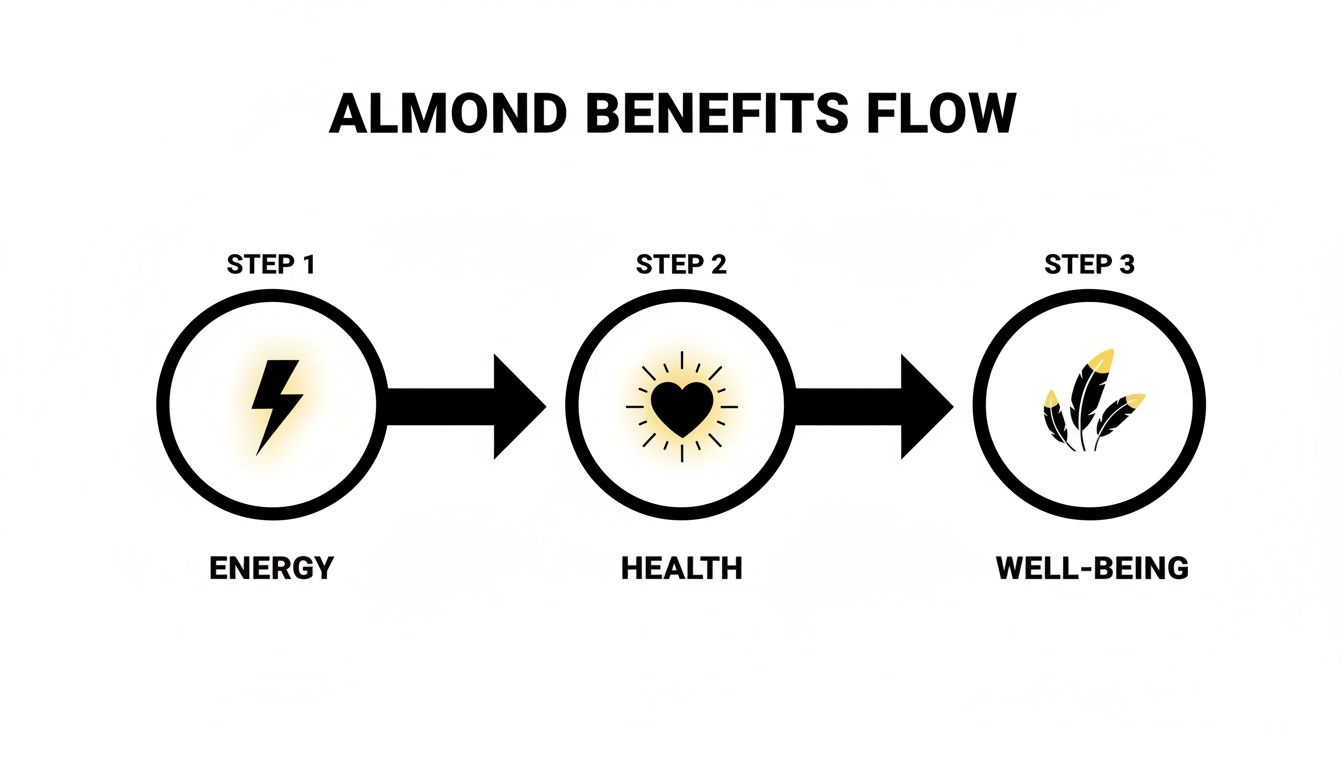
As you can see, the nutritional goodness inside the almond directly fuels your bird's body, which in turn contributes to their overall vitality and even the vibrancy of their feathers.
Combining Almonds with Foraging Toys
Once your parrot has mastered the art of cracking an almond, you can really dial up the challenge by tucking them inside dedicated enrichment toys. This layered approach creates an even more stimulating experience, getting closer to the complexity of finding food in the wild. You can find a fantastic range of foraging toys for birds that are perfect for this.
- The Foraging Fun Box: This is a brilliant starting point. Just pop an in-shell almond into one of the compartments and let your bird puzzle out how to get to it.
- The Seagrass Foraging Wall: For a tougher challenge, try weaving an almond into the natural seagrass matting. Your parrot will have to chew through the seagrass to get their reward—an excellent beak workout!
- DIY Skewers: You can carefully drill a hole through an almond shell and thread it onto a stainless-steel skewer with bird-safe wood blocks and other toy parts for a fun hanging puzzle.
Expert Advice: Avian behaviourists always recommend rotating different foraging challenges to keep things fresh. A parrot's intelligence thrives on novelty, so mixing up how you present treats like in-shell almonds is the best way to prevent boredom and keep them consistently engaged.
Repurposing Almond Shells for More Fun
And don't just toss the empty shells in the bin! As long as they're clean and free of any leftover kernel, the two halves of a cracked almond shell make fantastic foot toys. They’re lightweight and have a great curved shape, perfect for smaller parrots to pick up, throw around, and chew on.
You can also drop the empty shell halves into a small foraging tray filled with other safe goodies like shredded paper or wooden beads. Your bird will love the sensation of rummaging through all the different textures to find the shells, stretching the enrichment value of a single almond even further. It’s a great way to ensure nothing goes to waste while providing another layer of simple, cost-effective fun.
Potential Risks and How to Safely Avoid Them
Giving your parrot an in-shell almond is a fantastic way to keep them busy and happy, but just like any special treat, it comes with a few responsibilities. Knowing the potential risks and, more importantly, how to easily manage them is the key to making treat time a safe and positive experience. With a little bit of know-how, you can offer these engaging nuts with complete confidence.
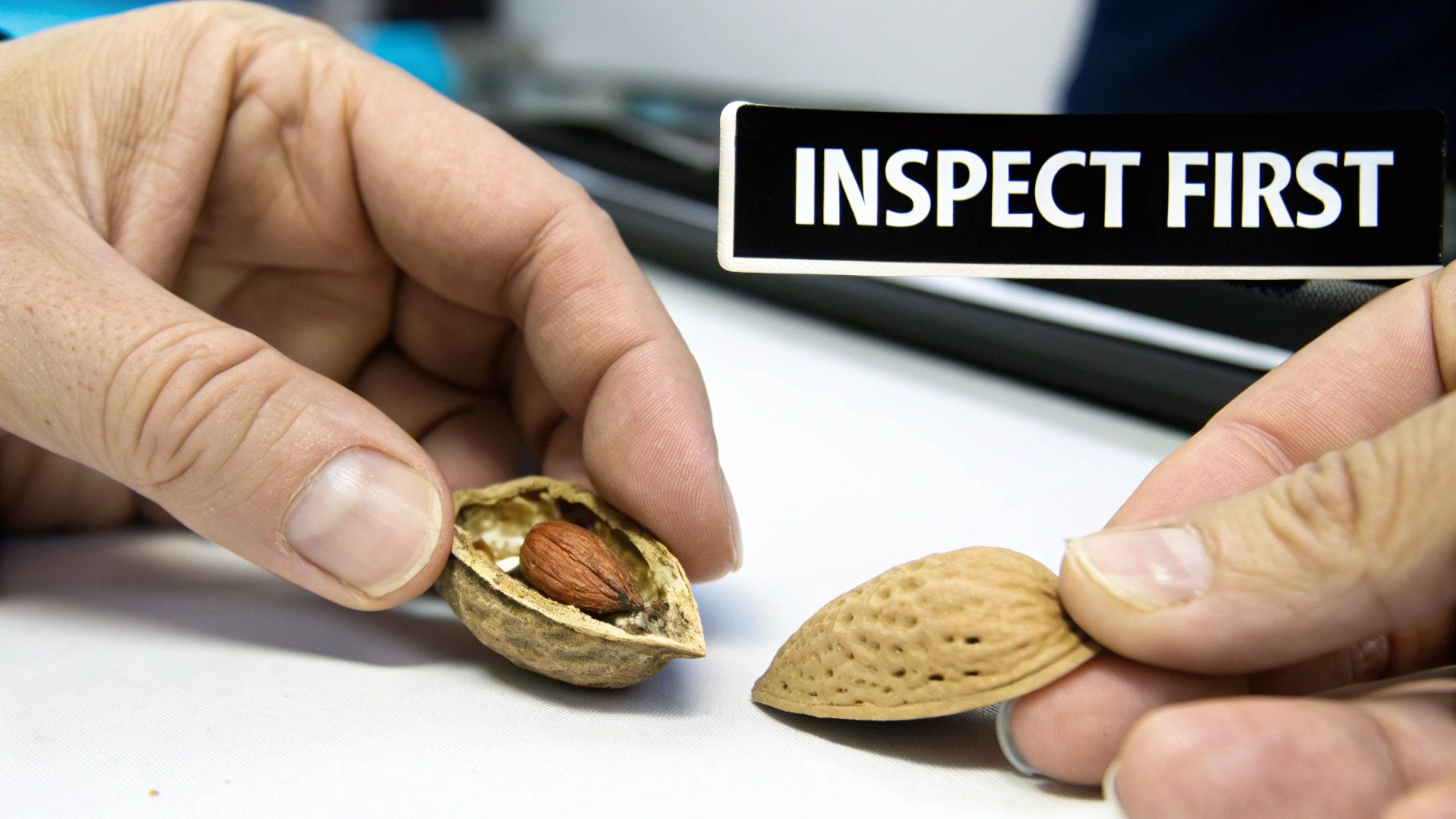
The main things to watch out for are actually pretty straightforward and simple to avoid. By being mindful of choking hazards, checking for mould, and not overdoing it, you can keep your feathered friend safe and happy.
Managing Choking Hazards
That tough almond shell is a brilliant beak workout for big parrots like Macaws and Cockatoos. For the smaller birds, though, that same shell can be an impossible barrier and even a potential choking risk if a piece snaps off the wrong way.
For medium-sized parrots like Galahs, Corellas, or Alexandrines, there's a simple trick: just pre-crack the shell for them. A quick squeeze with a nutcracker—enough to create a fracture but not open it completely—gives them a head start. It keeps the foraging challenge alive without the risk, letting them work for their treat safely.
Expert Advice: Never give a whole, intact in-shell almond to small birds like Cockatiels, Conures, or Quakers. Their beaks just aren't built for a nut that tough, and the risk of injury or choking is far greater than any benefit. Instead, just offer them a small piece of the kernel itself.
The Dangers of Mould and Aflatoxins
One of the most serious—but easily preventable—risks with any nut is mould. If stored improperly, especially in the humid climates we get across parts of Australia, almonds can develop mould. Some of these moulds produce nasty toxins called aflatoxins, which are invisible and can cause severe liver damage in birds.
Your best defence is buying from the right places and having a good inspection routine. Always get your nuts from reputable suppliers with a high turnover of stock, and keep them in an airtight container in a cool, dark, dry spot.
Before you hand over any nut, give it a quick once-over:
- Look: Does the shell have any dark spots, fuzzy bits, or weird discolouration?
- Shake: Does it rattle a lot? That can be a sign the nut inside has shrivelled up and gone bad.
- Smell: Crack it open. Does it smell like anything other than a fresh, nutty almond? A musty, sour, or "off" smell is a massive red flag.
If a nut seems even slightly suss, throw it out immediately. It's just not worth the risk. For a deeper dive into the specifics of shell safety, our guide on the almond nut shell offers some more detailed insights.
Avoiding the Pitfalls of Overfeeding
It’s so easy to get carried away when your parrot is clearly loving a particular treat. But it's so important to remember that almonds are very high in fat and calories. While these are the "good" fats that provide energy, too much of a good thing can lead to pretty serious health problems.
Obesity is a really common issue in pet parrots and can bring on related conditions like fatty liver disease, breathing issues, and sore joints. The best way to think of an almond is as a special dessert, not a daily snack. Stick to the portion guidelines we mentioned earlier in this guide, and use them as a high-value reward for training or as a special foraging challenge just a few times a week. That way, they stay a healthy, exciting part of a balanced diet.
How to Source and Store Almonds in Australia
Finding top-notch, fresh in-shell almonds is the first, and honestly most important, step to giving your bird this fantastic treat. Where you get your nuts from really matters—freshness and good handling are non-negotiable for avoiding health risks. With a bit of know-how, you can easily find the best almonds and store them properly, even with Australia's wild and wonderful climate.
When you're out shopping, always think fresh. Your best bet is usually a health food store, a good grocer with a high turnover of stock, or a dedicated nut supplier. Those bulk bins at the supermarket might look like a great deal, but they can be a bit of a gamble. You just don't know how long those nuts have been sitting there, exposed to air and light, which can make their healthy fats go rancid.
What to Look For When Buying
Use your senses to pick out the good ones. A quality in-shell almond should feel solid and surprisingly heavy for its size, with a clean, uncracked shell.
Here’s a quick mental checklist for your next shopping trip:
- Check the Shells: Look for smooth, unbroken shells. Steer clear of any with obvious cracks, holes, or dark, mouldy-looking spots.
- Listen Closely: Pop a nut next to your ear and give it a little shake. If you hear a loud, distinct rattle, it's a sign the kernel inside has dried out and shrivelled up with age.
- Ask About Origin: Whenever you can, go for Australian-grown almonds. They haven't travelled as far, which almost always means they're fresher.
Choosing local isn't just a great way to support our farmers; it means you're getting a premium product. Australian bird owners are lucky to have one of the world's most advanced almond industries right here. The industry is highly concentrated along the Murray-Darling corridor, with the majority of trees planted in just a few regions. This clever clustering keeps the travel time from orchard to shop short, meaning fresher stock for your flock. A quick look into the growth of the Australian almond industry shows just how big and sophisticated our local production has become.
Storing Almonds for Maximum Freshness
Once you’ve brought your fresh almonds home, storing them correctly is the next mission. You need to protect them from moisture, heat, and pests. The goal is simple: keep them cool, dark, and dry. An airtight container is your best friend here—a glass jar with a tight lid or a BPA-free plastic container works perfectly.
Keep the container in a cool, dark spot like a pantry or cupboard, well away from the stove or any sunny windows. For most of the year in many parts of Australia, that’s all you’ll need to do.
Expert Advice: During those hot, humid summers, especially if you're in places like Queensland or coastal New South Wales, the fridge is your best bet. The cool air slows down the oil oxidation in the nuts and, crucially, stops any potential mould from getting a foothold.
By being a bit picky about where you buy your nuts and smart about how you store them, you can be sure that every in-shell almond you offer is a safe, nutritious, and cracking good treat. Finding reliable parrot supplies in Australia from trusted sources is a cornerstone of responsible bird care.
Your Questions About In-Shell Almonds, Answered
Even when you've got the basics down, a few specific questions always seem to pop up when introducing something new. It's completely normal! Here are some quick, clear answers to the questions we hear most from the Australian bird community about in-shell almonds.
Are In-Shell Almonds Okay for Small Birds Like Budgies or Cockatiels?
While the almond kernel itself is safe in tiny, treat-sized amounts, the shell is a definite no-go for small birds. It’s simply too hard for the beaks of parrots like budgies, cockatiels, and lovebirds. Trying to crack one could lead to frustration or even a nasty beak injury.
The best way forward is to offer a sliver of the raw kernel as a special treat. If you want to give them a bit of a foraging challenge, you can pre-crack the shell yourself and tuck the pieces into a toy, letting them work to get the nut out. Just remember, they can't crack a whole one on their own, and you should always be around to supervise.
How Can I Tell If an In-Shell Almond Has Gone Bad?
Your own senses are the best tools you have for a quick quality check. Before you offer any nut to your bird, give it a once-over.
- Look at it: Check the shell for dark spots, any fuzzy mould, or big cracks that might have let moisture in.
- Shake it: Hold it up to your ear and give it a gentle shake. A loud, hollow rattle often means the kernel inside has dried out and shrivelled up.
- Crack it open: The kernel inside should be a firm, creamy-white colour.
If it looks off-colour, feels dried out, or has even a hint of a musty or sour smell, chuck it out. When in doubt, it’s always better to be safe than sorry.
Expert Advice: Aflatoxin, a dangerous toxin produced by certain moulds, is invisible and has no smell. This is why a thorough visual check of the shell for any sign of mould is so important—it’s your first and best line of defence.
Should I Wash or Cook Almonds Before Giving Them to My Parrot?
Never, ever cook or roast almonds for your bird. Raw and unsalted is the only safe way to go. Cooking changes their nutritional makeup and can make the fats really hard for a bird’s system to process.
It is, however, a great idea to give the outer shell a quick rinse under clean, running water. Just make sure you pat it completely dry with a paper towel before handing it over. This simple step gets rid of any surface dust or contaminants from handling, making it cleaner for your bird to hold and crack.
My Parrot Doesn’t Seem Interested in the Almond. What Should I Do?
Don't be discouraged! Parrots are naturally neophobic—which is just a fancy way of saying they’re suspicious of new things. Patience and a bit of playful encouragement are your best friends here.
Try tapping the almond on a perch or pretending to eat it yourself (without actually eating it, of course!) to show it’s a safe and interesting object. Another great trick is to crack the shell just enough so the kernel is visible; the sight and smell might be enough to tempt them. You could also try weaving it into a familiar toy they already love. It might take a few tries before your feathered friend decides it's worth investigating.
At Lou Lou Bells Bird Toys, we believe enrichment is at the heart of a happy bird's life. Explore our huge range of safe, engaging, and handcrafted toys designed right here in Australia to keep your companion thriving. Find the perfect puzzle or shreddable delight for your bird at https://louloubellsbirdtoys.com.au.
Keep Reading
- Are Peanuts Safe for Parrots
- A Guide to Natural Bird Toys
- Choosing Safe Wood for Parrot Toys
Disclaimer Summary:
The information in this article is general in nature and may include external links or resources not created by Lou Lou Bells Bird Toys. Every bird is unique, so we encourage you to seek personalised advice from your own veterinarian or avian specialist. For full details, please read our complete disclaimer here.