
Building a backyard aviary is about so much more than just putting up a cage. It's about creating a safe, thriving sanctuary where your feathered friends can truly flourish, enjoying natural sunlight, fresh air, and the freedom to fly. As a bird enthusiast, I've seen firsthand how an outdoor space can transform a bird's life, and I'm here to share some practical advice to help you get it right.
Your Dream Aviary Starts With A Smart Plan

Before you buy a single sheet of wire mesh or cut the first piece of timber, the most critical work happens with a pen and paper. I've seen it time and time again: a well-thought-out plan is the foundation of a successful aviary. It saves you from costly mistakes down the track and, most importantly, ensures the long-term wellbeing of your birds.
Making the move from an indoor cage to an outdoor aviary is a massive upgrade for their quality of life. That access to natural UV light is essential for vitamin D3 synthesis, which is crucial for calcium absorption, strong bones, and healthy egg-laying in our Australian climate. And the sheer space? It allows for proper flight, which is absolutely vital for their physical and mental health.
Why Planning Ahead Is Non-Negotiable
A solid plan isn't just a sketch of the structure; it's a blueprint for a thriving habitat. Here’s what you really gain by being meticulous from the get-go:
- Enhanced Safety: You can design predator-proofing from the ground up, rather than trying to patch vulnerabilities later on.
- Improved Bird Health: Thoughtful placement ensures your birds get that lovely morning sun without being scorched by the harsh Australian afternoon heat.
- Long-Term Durability: Choosing the right materials for our local climate from the start means less maintenance and a much longer life for your aviary.
- Stress-Free Management: Thinking ahead to include features like a double-door safety porch and easy-to-clean flooring makes daily care so much simpler for you.
My Two Cents: I always tell people to try and think of their aviary from the bird’s perspective. Where will they feel safest from predators? Where can they catch the morning sun? A happy bird is a healthy bird, and it all starts with empathetic design.
Building an aviary is a real commitment, but the reward of seeing your birds flourishing in a semi-natural environment is immeasurable. This process goes beyond simple construction; it's about deeply understanding and meeting the fundamental needs of your companions. For a deeper dive into foundational bird care, our essential guide to caring for pet birds provides heaps of valuable insights to complement your aviary planning.
Choosing the Perfect Aviary Location and Design
Getting the location and design right for your outdoor aviary are the two biggest decisions you'll make. Everything else flows from these choices. Get them wrong, and you could end up with a sun-baked oven in summer or a wind-blasted freezer in winter, creating a miserable, stressful environment for your birds.
It’s far, far easier to get this right from the start than to try and fix a poorly placed aviary later. Think of yourself as a property developer for your flock. Your job is to find the prime bit of real estate in your backyard that offers the best of everything. In Australia, that means being smart about the sun.
Finding the Ideal Location in Your Garden
The perfect spot isn't always the one that looks prettiest from your kitchen window; it has to work for the birds first. Before you do anything else, spend a few days watching your garden at different times of the day.
You're hunting for a spot that gets plenty of gentle morning sun. This is absolutely essential for your birds to warm up, preen, and soak up that vital vitamin D. But just as important is ensuring it has reliable shade or is positioned to escape the relentless, scorching heat of an Aussie afternoon, especially from the west.
Here’s a quick checklist for scouting the perfect aviary spot:
- Sun Exposure: Does it get that lovely eastern sun in the morning? Is there natural shade from trees, or maybe your house, to block the harsh western sun after midday?
- Wind Protection: Can you tuck it in somewhere with shelter from those biting southerly winds? A solid fence, the side of your house, or even a shed can make a fantastic windbreak.
- Drainage: Take a look at the ground. Is it level or does it have a slight slope? You must avoid low-lying areas that turn into a bog every time it rains. That’s just a recipe for disease and pests.
- Proximity to Home: You want it close enough that feeding and cleaning aren't a massive chore, but not so close that constant household noise and activity cause stress. Too much noise can even lead to problem behaviours like constant squawking. We've got a great guide on why parrots squawk and how to deal with it if that's a concern.
Expert Advice: I always tell people to sketch their backyard and map the sun's path. Make a note of where the shade falls at 9 am, 12 pm, and 3 pm in both summer and winter. It’s a simple exercise, but it will show you the best and worst zones for your aviary way better than guesswork ever could.
Tailoring the Design to Your Birds
Once you've scouted your location, it's time to think about a design that suits the specific species you plan to keep. An aviary is definitely not a one-size-fits-all project. The needs of a flock of tiny finches are worlds apart from those of a big, powerful cockatoo.
The most fundamental design choice you'll make is orientation: long versus tall.
- Long Flight Aviaries: Perfect for finches, canaries, and budgies. These little guys fly horizontally, so giving them as much length as possible allows them to get proper exercise. A design that's 4 metres long but only 2 metres high is infinitely better for them than one that is 2 metres long and 4 metres high.
- Tall Climbing Aviaries: Larger parrots like Galahs, Eclectus, and Macaws are climbers just as much as they are flyers. They need that vertical space for clambering up and down mesh walls and big branches. A taller design gives you the freedom to create a complex jungle gym of perches and toys to keep their sharp minds engaged.
Beyond the basic shape, your design must include a few non-negotiable features. The most important of these is the double-door safety porch. This is a small, two-door entryway that works like an airlock. You enter the first door, close it securely behind you, and only then open the second door into the main aviary.
Honestly, this simple feature is the single most effective way to prevent heartbreaking accidental escapes. Don't even consider building an aviary without one.
Selecting the Right Aviary Building Materials
Alright, you’ve picked your spot and sketched out a design. Now comes the really critical part: choosing the materials for your outdoor aviary. This decision goes way beyond looks. It directly affects how safe your birds are, how long the structure will last, and frankly, how much time you’ll spend on upkeep down the track.
Here in Australia, our conditions can be brutal. We're talking scorching sun, sudden downpours, and some very determined local wildlife. Your materials need to be tough enough to handle all of it.
Think of smart material choices as an investment. A cheap frame might save you a few dollars today, but it could lead to costly repairs or, worst-case scenario, a structural failure that puts your birds at risk.
Framing Your Aviary For Strength
The frame is the skeleton of your aviary—it has to be solid. While treated pine is a common go-to for DIY projects because it's cheap and easy to find, it comes with a huge red flag for anyone with parrots. I've seen big parrots chew through a pine frame in a shockingly short amount of time, creating escape routes or dangerous weak points.
For that reason alone, I always steer people towards a metal frame.
- Steel (Galvanised or Powder-Coated): This is your top choice for large, destructive parrots. It’s incredibly strong, completely beak-proof, and built to last. It is heavier and can be a bit more work to put together, but you can’t beat its durability.
- Aluminium: A fantastic, long-lasting option that's lighter than steel and naturally rust-resistant. It's perfect for most bird species and is far easier to work with, making it a great pick if you're planning a custom build.
Expert Advice: Whichever frame you go with, make sure every single screw, bolt, and fitting is stainless steel. Standard galvanised hardware will eventually rust, especially if you're near the coast, and that creates weak points. It’s a small detail that makes a massive difference to the aviary's lifespan.
When you're settling on a design, the type of bird you have is the biggest factor. Their natural behaviours really dictate the best shape. This simple decision tree can help you visualise whether you should be building for length (for flyers) or height (for climbers).
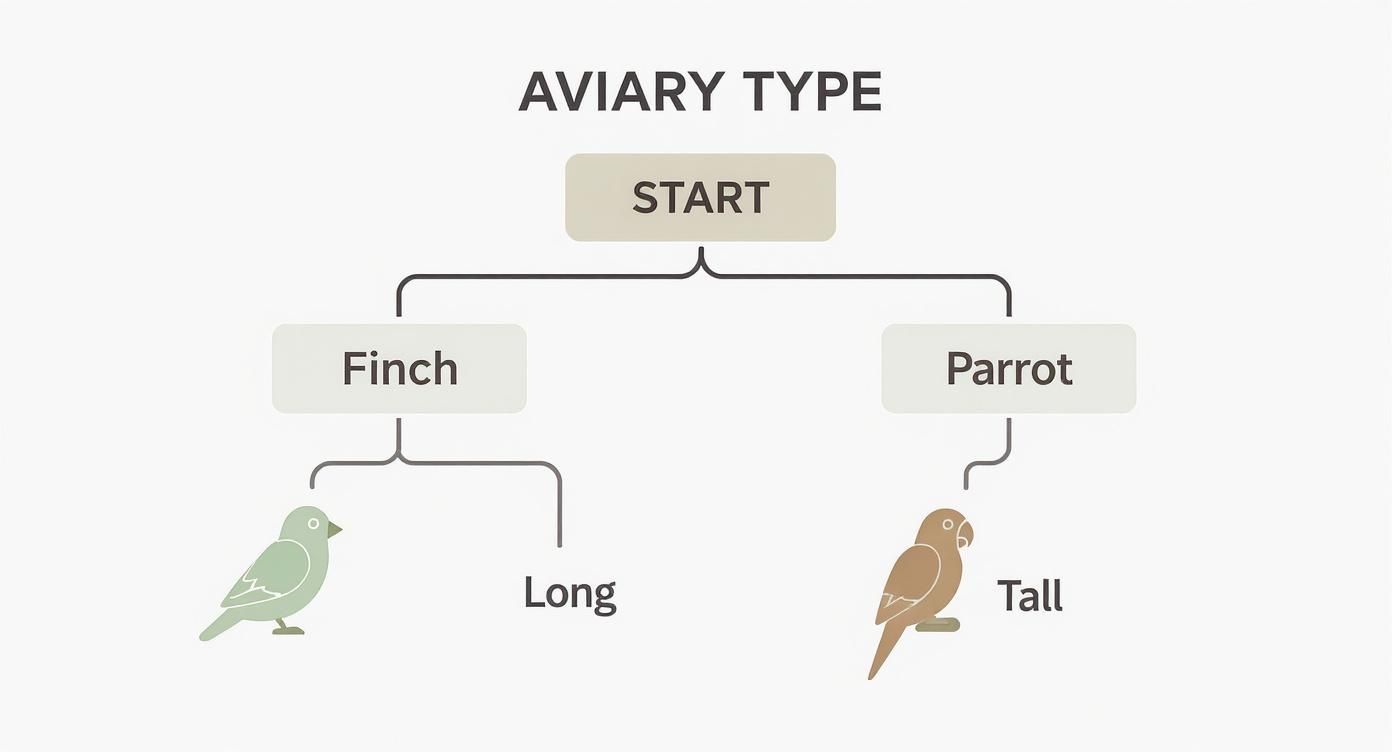
As you can see, finches need that horizontal space to really stretch their wings in flight, while parrots get more out of vertical space where they can climb and play.
Choosing The Right Wire Mesh
If there’s one place you absolutely cannot cut corners, it’s the wire mesh. This is arguably the most critical component for your birds' safety. Good mesh keeps your birds in and, just as importantly, keeps predators out.
There are three key things to look at:
- Aperture (Hole Size): The holes need to be small enough that your smallest bird can't poke its head through. For parrots, smaller holes also stop them from getting a beak-hold to start chewing on the wire.
- Gauge (Wire Thickness): With wire gauge, the higher the number, the thinner the wire. A 19-gauge wire might be fine for finches, but parrots need something much tougher. You should be looking for 12.5-gauge or even 10-gauge to stand up to those powerful beaks.
- Material and Coating: Standard galvanised mesh is everywhere, but it can pose a zinc toxicity risk if your birds are chewers. Powder-coated or PVC-coated mesh is a step up, but the absolute gold standard for safety and rust-resistance is stainless steel. It's the most expensive option upfront, but it will outlast everything else and is the safest choice you can make.
Choosing the right wire mesh can feel a bit overwhelming, so here’s a quick rundown of the most common options to help you decide what’s best for your flock.
Aviary Wire Mesh Comparison for Australian Birds
| Mesh Type | Best For | Pros | Cons | Estimated Cost (per metre) |
|---|---|---|---|---|
| Galvanised Welded Mesh | Finches, softbills, small non-chewing birds | Affordable, widely available, decent strength. | Risk of zinc toxicity for chewers, will eventually rust. | $8 - $15 |
| Powder-Coated/PVC Mesh | Small to medium parrots, cockatiels | Safer than plain galvanised, better rust protection, good visibility. | Coating can be chipped or chewed off by strong beaks. | $15 - $25 |
| Heavy Gauge Welded Mesh | Large parrots (Macaws, Cockatoos) | Extremely strong (10-12.5 gauge), resists powerful beaks. | Can be heavy and difficult to work with, still a rust risk over time. | $20 - $35 |
| Stainless Steel Mesh | All bird species, especially heavy chewers and sensitive birds | 100% bird-safe (no zinc risk), will not rust, extremely durable. | Highest upfront cost, can be harder to source. | $40 - $70+ |
Ultimately, stainless steel is the premium choice for peace of mind, but a heavy-gauge coated wire is also a very solid option for most parrot setups.
Roofing and Flooring Foundations
The roof is all about providing shelter from our harsh sun and rain. A fully covered roof is a safe bet, but some people opt for a partially covered design so their birds can enjoy a natural rain shower now and then.
- Colorbond Steel: A classic Aussie choice for a reason. It's durable, long-lasting, and provides excellent shade and protection from the elements. Plus, it comes in loads of colours.
- UV-Stable Polycarbonate: This stuff is great because it lets in natural light while blocking harmful UV rays. It creates a really bright, airy feel and works perfectly for the "open" section of a partially covered roof.
When it comes to the floor, you’ve got two main options. A poured concrete slab is the gold standard for hygiene and predator proofing. It’s dead easy to hose down and disinfect, and nothing is digging through it. The other path is a natural substrate floor using sand, soil, and leaf litter. This is fantastic for encouraging natural foraging, especially for ground-dwelling birds, but it requires a lot more work to keep it dry and clean.
Building an aviary from scratch means you'll be sourcing a lot of different bits and pieces. For a good overview of all the items you might need on your shopping list, take a look at our guide on essential parrot supplies in Australia.
How to Predator-Proof Your Aviary
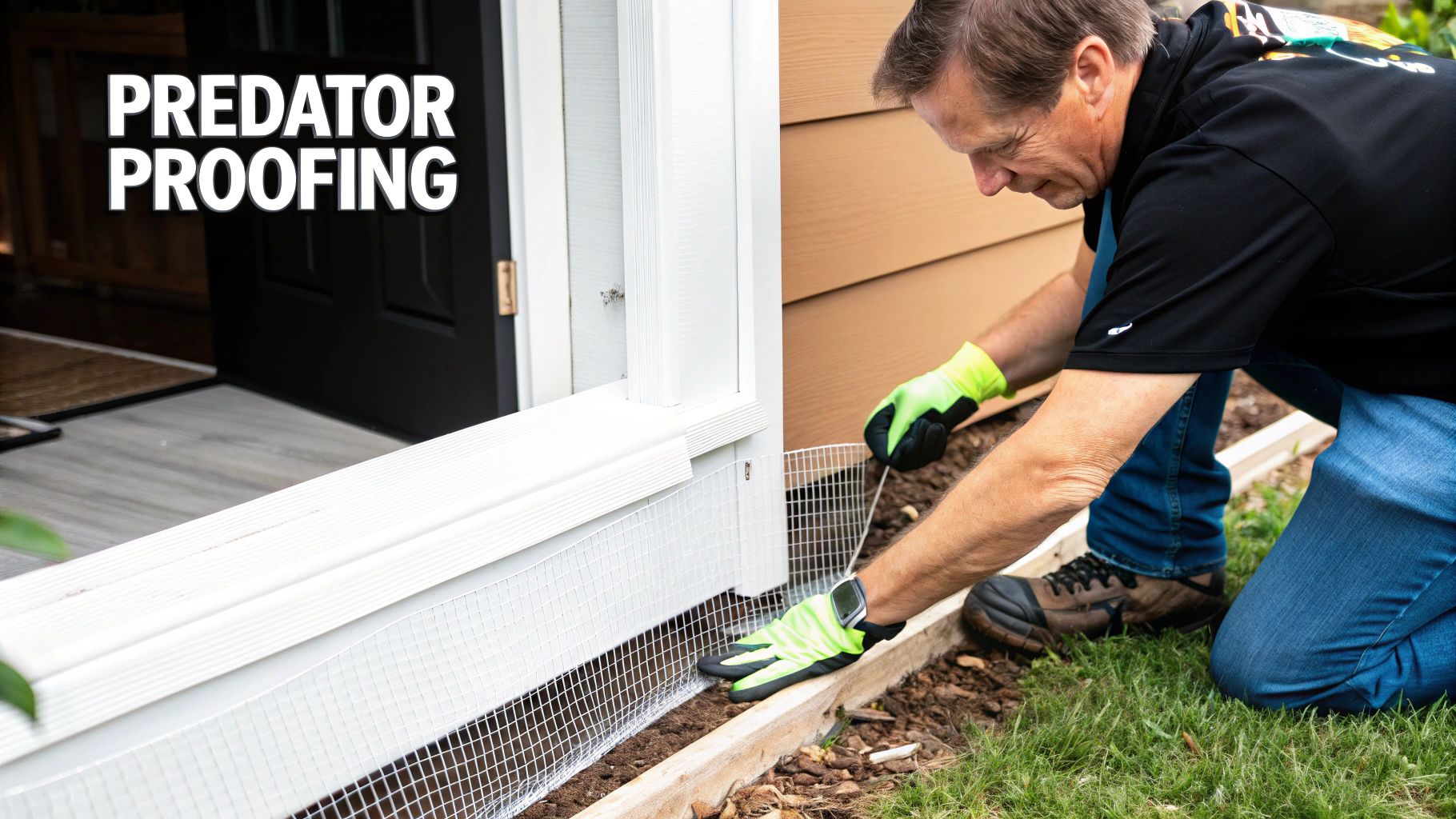
Building a beautiful aviary for your birds is a fantastic project, but let's be blunt: your absolute number one priority has to be safety. To a predator, an aviary can look like an all-you-can-eat buffet, and here in Australia, we’ve got a unique and very determined lineup of threats.
True peace of mind only comes when you know your structure is an impenetrable fortress.
Your security plan needs to be built from the ground up, literally. You have to think about threats that dig, climb, and fly. This isn't about being paranoid; it's about responsible bird ownership. A single weak point is all a determined snake or fox needs to cause absolute devastation.
Identifying Common Australian Predators
In Australia, the threats to your flock are incredibly varied. You’ve got to consider everything from tiny intruders to powerful, cunning reptiles. Each one needs a different strategy to defeat it.
Here are the main culprits you need to build defences against:
- Snakes and Goannas: These reptiles are absolute masters of climbing and can squeeze through unbelievably small gaps. They're a major threat across most of the country.
- Rodents (Rats and Mice): They don't just steal food and spread disease; rats are more than capable of killing small birds. They are notorious for finding tiny entry points you might easily overlook.
- Predatory Birds: Butcherbirds, currawongs, and even kookaburras can harass your birds from outside or try to pull feet and wings through the mesh if the aperture is too wide.
- Foxes and Feral Cats: These are cunning nocturnal hunters who are experts at digging and testing the weak points of your aviary's frame.
Keeping these threats in mind from day one helps you build a multi-layered defence system that protects your flock from every possible angle.
Building Your Defences from the Ground Up
The most common way in for determined predators like foxes, goannas, and rats is from underneath. They will dig tirelessly at the base of your aviary, looking for a way in. While a concrete slab floor is the ultimate fix, an underground barrier is completely non-negotiable if you’ve chosen a natural substrate.
This involves digging a trench around the entire perimeter of your aviary. It needs to be at least 30 cm deep and 30 cm wide. You then line this trench with tough, fine-gauge mesh, creating an "L" shape that extends outwards, away from the aviary wall. When a predator tries to dig down, it hits this buried mesh and simply can't get any further.
Expert Advice: I always recommend a heavy-duty, galvanised or stainless steel mesh for this skirting. It has to be securely fastened to the main aviary frame to ensure there are absolutely no gaps a snake or mouse could exploit. It's a lot of work upfront, but it’s the absolute bedrock of a truly secure outdoor bird aviary.
Beyond digging, you have to meticulously secure every single corner, join, and door. Use stainless steel bolts and double-check that there are no gaps wider than a few millimetres where wire panels meet the frame. Predators are brilliant at finding and exploiting the slightest weakness.
The Non-Negotiable Safety Porch
Here's a hard truth: the single biggest risk for accidental escapes isn't a predator breaking in, but a bird flying out when you go in. This is why a double-door 'safety porch' is the most important feature you can possibly build. Think of it as an airlock for your aviary.
Here's how it works:
- You open the outer door and step into a small, fully enclosed porch.
- You close this outer door securely behind you.
- Only then do you open the inner door to enter the main aviary flight.
This simple system makes it virtually impossible for a bird to dart past you and escape. If a bird does happen to get into the porch, it's still a secure, contained space where you can easily return it to the main flight. Never, ever build an outdoor aviary without one. It's the most crucial element for preventing a heartbreaking loss.
Creating an Enriching and Stimulating Habitat
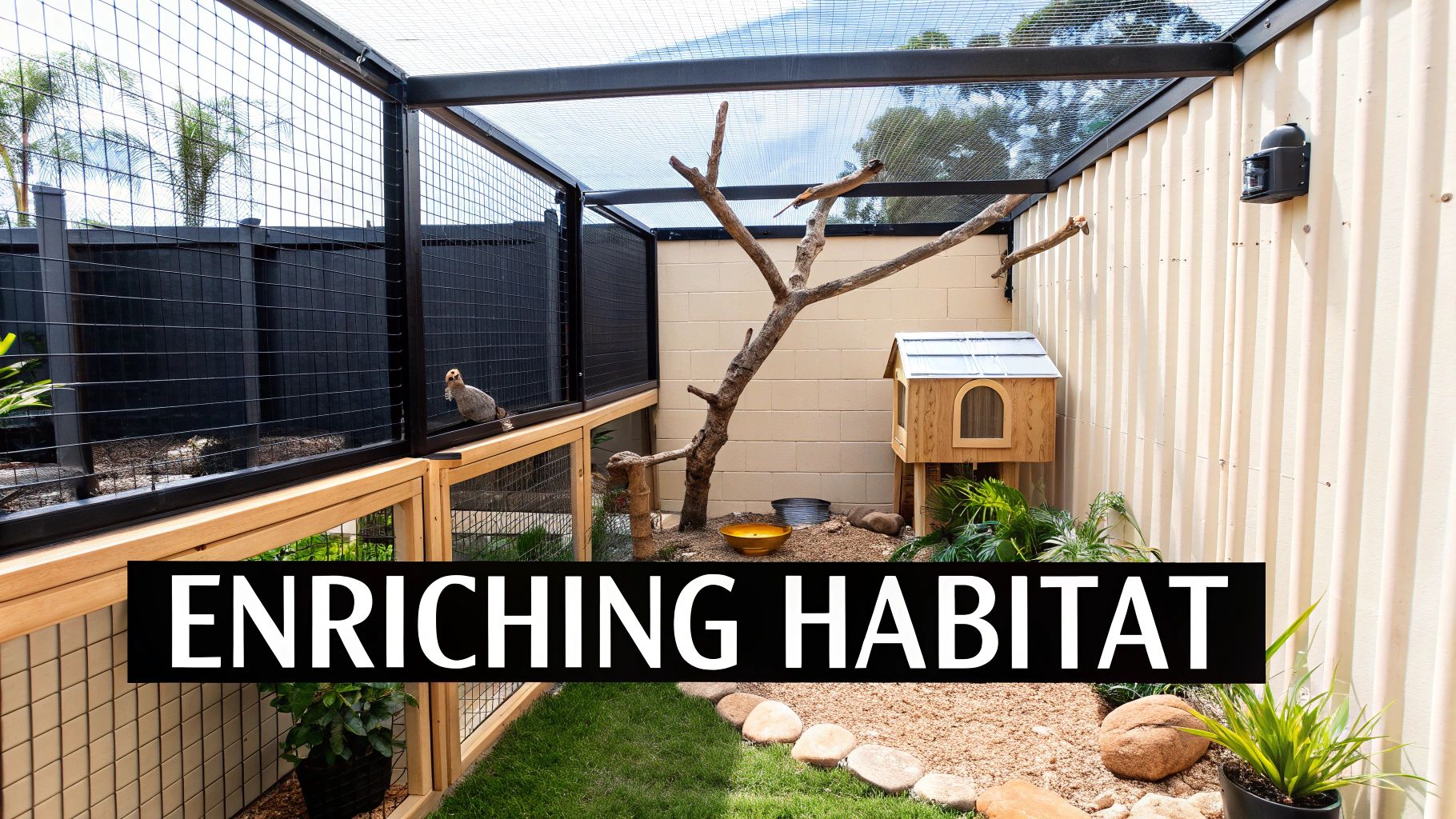
Alright, you’ve built a secure, weatherproof structure. Now for the really fun part: turning that outdoor bird aviary from a simple box into a vibrant, living habitat.
An empty aviary is a wasted opportunity. The goal is to create a space that encourages all those natural behaviours we love to see—flying, climbing, foraging, and just being a bird. This is how you create an environment that’s not just safe, but also mentally and physically engaging for your flock. A thoughtfully furnished aviary is what separates a bird that’s merely surviving from one that’s truly thriving.
Setting Up Perches For Healthy Feet and Flight
Forget dowel perches. Seriously. The single best thing you can do for your birds' foot health is to use natural branches from bird-safe Australian native trees. Think Eucalyptus, bottlebrush, and grevillea—they're all excellent choices.
The secret is variety. You want branches of all different thicknesses, shapes, and textures. This forces your birds to constantly adjust their grip, giving the muscles and tendons in their feet a proper workout and helping prevent nasty issues like pressure sores and arthritis.
When you're placing the perches, think like an air traffic controller. Your aim is to map out clear, open flight paths from one end of the aviary to the other.
- Create Flight Lanes: Position the main perches at opposite ends. This encourages long, powerful flights rather than just a few clumsy hops.
- Establish Zones: Think about designating areas for different activities. High, sheltered perches are perfect for a quiet roost, while lower perches near food stations create a natural feeding zone.
- Vary the Heights: A good mix of high and low perches lets your birds choose their favourite vantage point and encourages climbing, which is fantastic exercise.
Expert Advice: I always tell people to avoid placing perches directly above food or water bowls. It’s such a simple mistake, but it guarantees droppings will contaminate their resources, leading to potential health problems. Keep that feeding area clear from above!
Engaging Intelligent Minds With Toys and Foraging
A bored parrot is often a destructive or stressed parrot. In an outdoor aviary, you've got the space to offer a fantastic range of enrichment to keep those clever minds whirring. Intelligent birds don't just want things to sit on; they need puzzles to solve and things to destroy.
Foraging is a bird’s natural drive to search for food. Hiding treats inside toys turns mealtime from a two-minute affair into a stimulating challenge that busts boredom and promotes mental wellbeing.
Tough, durable toys are a must for those powerful beaks. A great example is the Foraging Fiesta Bell, which is built to withstand some serious chewing while making your bird work for its reward. But satisfying their urge to shred is just as important. Toys like the Native Gnaw Tower are perfect for this, made from natural, chewable materials that fulfil this deep-seated need.
You can find more inspiration by exploring the world of foraging toys for birds to see what might be a hit with your flock.
Adding Natural Cover With Bird-Safe Plants
Finally, bringing some bird-safe, native plants into your aviary provides natural cover and another layer of enrichment. Plants offer shade, privacy, and a sense of security, giving birds a place to retreat to when they feel a bit nervous.
When choosing plants, you have to be 100% sure they are non-toxic to your specific bird species. Some fantastic choices for Australian aviaries include:
- Grevillea (Spider Flower)
- Callistemon (Bottlebrush)
- Melaleuca (Paperbark)
These plants don’t just offer great natural perching and climbing spots; they might also provide edible flowers and seeds. I recommend planting them in large, heavy pots. This stops your birds from digging up the roots and makes cleaning the aviary floor much, much easier. It's this final touch that truly brings the whole space to life.
Navigating Council Rules and Wildlife Licences
Right, before you even think about picking up a hammer for that dream outdoor aviary, there's some crucial groundwork to lay that has nothing to do with concrete or wire mesh.
Here in Australia, building structures and keeping animals—especially native ones—is often regulated. Trust me, finding out you’ve missed a step after the work is done is a headache you really want to avoid. Think of sorting out the paperwork as the very first part of the build; it’s just as important as the foundation itself.
First Stop: Your Local Council
Your first phone call should always be to your local council. In their eyes, an aviary isn't much different from a garden shed or a pergola, and every council has its own rulebook for backyard structures.
The regulations usually come down to a few key things:
- Size and Height: There are often limits on how big a structure can be before you need to lodge a formal development application (DA). For example, it’s common for anything over 10 square metres or 3 metres high to need a permit.
- Location on Your Property: Rules about how close you can build to a boundary fence—known as 'setbacks'—are pretty standard across the board.
- Visual Impact: Some councils, particularly in newer estates or heritage areas, might even have a say in the materials and overall look of your aviary.
Honestly, the best thing you can do is just give them a ring. A quick chat with the planning department to explain what you’re hoping to build can save you a world of trouble later on.
Expert Advice: When you call the council, have your proposed dimensions and a rough idea of where it’ll go on your property ready. It shows you’ve done your homework and helps them give you clear, specific advice straight away.
Getting to Grips with State Wildlife Licensing
If your heart is set on keeping native Australian birds, you'll need to look past council rules and into state-level wildlife laws. The history of aviculture in Australia is tied closely to the conservation and regulated breeding of our unique species. Because of this, holding and trading native birds has been managed through permits and wildlife protection laws for decades. You can learn more about the background from the Parliament of Australia's overview of commercial bird trade regulation.
What this means for you is that you will almost certainly need a wildlife licence.
These are issued by state authorities, like the Department of Environment and Water in South Australia or the National Parks and Wildlife Service in NSW. The type of licence you’ll need usually depends on the species you want to keep, as they’re often categorised by how rare they are or how difficult they are to care for.
Don't Forget the Neighbours
Finally, ticking all the legal boxes is one thing, but being a good neighbour is just as important for a peaceful life.
Let’s be honest, some birds can be noisy, especially at dawn and dusk. A bit of thoughtful placement—positioning the aviary as far from your neighbours' windows or outdoor living areas as possible—can make a huge difference.
Keeping things clean is also non-negotiable. A well-designed aviary with good drainage and a regular cleaning schedule shouldn’t create any odour problems. A little consideration really does go a long way in making sure your aviary is a welcome addition to the neighbourhood, not a source of conflict.
A Few Common Aviary Questions Answered
Building an outdoor aviary is a fantastic project, but let's be honest, it brings up a lot of questions. Over the years, I've heard just about all of them from fellow Aussie bird lovers. Here are the answers to some of the most common ones that pop up.
How Much Does a DIY Aviary Cost in Australia?
This is the big one, and the honest answer is: it varies wildly. The cost of building your own outdoor bird aviary really depends on the size, what materials you choose, and how complex you want to get.
For a smaller, more straightforward DIY setup using treated pine and standard galvanised mesh, you could get started for around $800 to $1,500. But if you're picturing a larger, more permanent structure with a full concrete slab and top-of-the-line stainless steel mesh, that budget can quickly jump to $5,000 to $10,000, or even more.
If there's one piece of advice I can give you, it's this: never, ever skimp on the quality of your wire mesh and door locks. It's the single best investment you'll make for your birds' safety and your own peace of mind.
What Is the Best Aviary Flooring for Hygiene?
When it comes to hygiene and keeping predators out, a sealed concrete slab is the undisputed king. It's an absolute breeze to hose down and disinfect, and it creates a solid barrier that stops anything from digging its way in. Simple and effective.
Another option, especially for ground-dwelling birds like quail and finches, is a natural 'deep litter' floor using sand and leaf mulch. This is great for encouraging natural foraging behaviours, but it demands more work from you. You have to be diligent about keeping it dry and clean to stop mould and bacteria from taking hold.
Expert Advice: If you do go with a natural floor, installing a buried mesh skirting around the entire base of the aviary isn't optional—it's essential. This is your number one defence against digging predators like foxes and goannas.
Can I Keep Different Bird Species Together?
Mixing different bird species in an outdoor aviary needs to be done with extreme care and a lot of research. It can be done, but it's not always straightforward.
While some birds, like many Australian finches, can coexist peacefully, mixing parrots of different sizes can be a recipe for disaster. Territorial fights can break out in an instant, leading to serious injuries or worse.
Always look into the temperament of every single species you plan to house together and make sure there is more than enough space for everyone to have their own territory. A golden rule I live by is to never house large, powerful parrots with small, delicate birds. The risk is just far too high.
Once your aviary is built, the final touch is enriching it with safe, stimulating toys to create a true bird paradise. Here at Lou Lou Bells Bird Toys, we handcraft a massive range of toys right here in Australia. From our shreddable Native Gnaw Tower to the engaging Foraging Fiesta Bell, we have everything you need to keep your feathered mates happy, healthy, and busy.
Disclaimer Summary:
The information in this article is general in nature and may include external links or resources not created by Lou Lou Bells Bird Toys. Every bird is unique, so we encourage you to seek personalised advice from your own veterinarian or avian specialist. For full details, please read our complete disclaimer here.